
Bo Polny: Financial Prophet or Market Mystic?
Sept 9, 2026
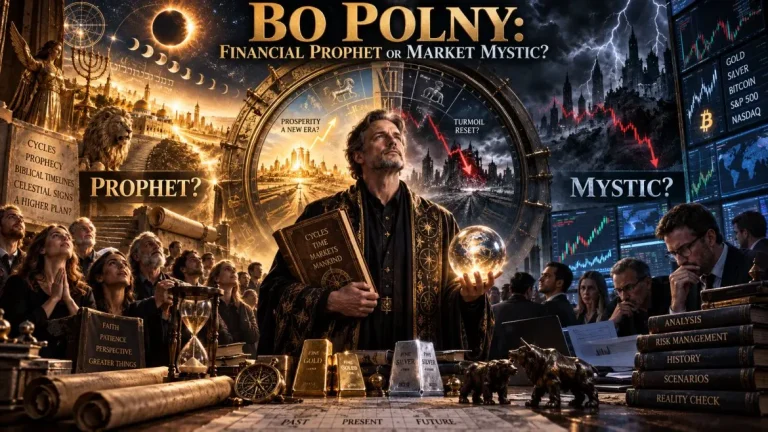
In the world of financial prediction, truth and illusion can look remarkably similar until the forecast meets reality. Bo Polny occupies an unusual position within that world, combining cycle analysis, precious-metals conviction, technical methods, biblical numerology, and spiritual prophecy into a framework that is difficult to classify as either conventional market analysis or pure religious forecasting. To his followers, this combination provides a deeper explanation for market cycles; to his critics, it turns uncertain financial events into narratives of predetermined destiny.
Polny has made forecasts ranging from major gold advances to global monetary resets, sometimes attaching remarkably specific dates to events that most analysts would describe only in probabilities. His appeal therefore extends beyond prediction accuracy because he offers something many conventional analysts do not: an overarching explanation for why financial disorder exists and where it is supposedly leading. The central question is whether his cycle methodology identifies genuine market rhythms or whether the occasional spectacular hit creates confidence in a framework whose broader predictive record remains considerably less convincing.
The Alchemist’s Paradox: Hard Money in an Age of Magic
At the centre of Polny’s worldview is a profound distrust of modern money. He portrays central banking, quantitative easing, and debt creation as forms of financial alchemy that manufacture apparent wealth while weakening purchasing power, and he positions gold and silver as monetary anchors capable of surviving the eventual consequences of currency debasement. This places him broadly within the hard-money tradition, although Polny adds a spiritual dimension that transforms monetary analysis into something closer to a theory of financial morality.
That produces an intriguing contradiction in his framework. He argues that markets are manipulated by powerful actors and distorted by an unstable monetary system, yet he simultaneously maintains that those markets follow highly predictable mathematical and biblical cycles that can reveal future turning points. The market consequently becomes both a manipulated crime scene and a perfectly ordered clock, an apparent contradiction that also explains much of his appeal because it allows followers to believe that even financial chaos has an underlying pattern.
Technical Prophecies: Decoding the Divine Algorithm
Polny’s methodology is built around cycles rather than conventional valuation. He searches for recurring temporal patterns across weekly, monthly, and longer historical periods, while incorporating the golden ratio, Fibonacci relationships, Elliott Wave theory, biblical timelines, Jewish feast days, and numerological relationships derived from scripture.
The golden ratio, or phi at approximately 1.618, is particularly important to his framework. Polny extends the concept beyond its mathematical and geometric applications, arguing that similar proportions can appear in financial timing and market structure, while biblical dates provide another layer through which potential turning points can supposedly be identified. Conventional critics see this as numerological pattern recognition applied to noisy data, whereas supporters regard the combination as a broader framework for detecting relationships conventional models overlook.
The attraction is obvious: conventional analysts usually discuss probabilities over broad periods, while Polny is willing to attach specific dates and dramatic outcomes to his forecasts. That specificity creates the possibility of spectacularly visible successes, but it also makes failures much easier to measure, particularly when the predicted event does not occur within the stated timeframe.
The Golden Thread: A Track Record of Hits and Misses
Polny’s record is best understood through individual forecasts rather than through the mythology surrounding them. His reputation received a major boost from his late-2019 warning of a significant market collapse in early 2020, which appeared remarkably prescient when markets plunged during the COVID crisis. His long-term bullish stance on precious metals also aligned with the major gold advance that began in 2019 and continued into the following years, providing legitimate evidence that his cycle work can sometimes identify important directional shifts.
The problem emerges when specific targets and dates are examined alongside those successes. His repeated forecasts of imminent dollar collapse and hyperinflation did not materialize as described, while his prediction that Bitcoin would reach $222,000 by November 2021 failed dramatically when Bitcoin peaked near $69,000 before entering a prolonged decline. His silver forecast of $600 by 2023 was similarly far removed from reality, demonstrating why directional accuracy and precise forecasting must be evaluated separately.
| Polny’s Market Prophecies: Golden Insights or Fool’s Gold? | Outcome | Verdict |
|---|---|---|
| 2020 Market Crash, predicted in late 2019 | Markets crashed dramatically in March 2020 | Direct Hit |
| Gold bull market beginning in 2019 | Gold entered a major uptrend, rising from roughly $1,200 to above $2,000 | Hit |
| Bitcoin to $222,000 by November 2021 | Bitcoin peaked around $69,000 before declining sharply | Major Miss |
| Dollar collapse in 2021/2022 | The dollar strengthened considerably against major currencies | Opposite Outcome |
| Silver to $600 by 2023 | Silver remained below $30, nowhere near the target | Major Miss |
| Global economic reset tied to biblical dates | No clear evidence of the specified reset occurred on those dates | Unconfirmed |
The table reveals the central problem with Polny’s methodology: a major successful forecast can be highly memorable without establishing that the entire forecasting system possesses reliable predictive power. A trader can be directionally right about a cycle while being catastrophically wrong about its timing, magnitude, or mechanism, and markets ultimately punish those distinctions.
Edge Cases: Where Analysis Meets Apocalypse
Polny’s analysis becomes most distinctive when financial cycles intersect with theology. His use of “God’s dates,” biblical calculations, economic Jubilees, and anticipated monetary resets takes his work well beyond conventional technical analysis, while his broader claims about elite control and the suppression of precious metals place him close to the boundary between documented market manipulation and expansive theories about coordinated financial power.
There is a legitimate distinction worth preserving here. Market manipulation is real and has been documented in financial markets, including cases involving precious-metals trading, but evidence of specific manipulation does not automatically establish a comprehensive theory in which a coordinated hidden group controls the global monetary system. Polny’s framework frequently moves from the former into the latter, which gives his forecasts a powerful narrative structure but also makes them difficult to falsify when events fail to occur exactly as predicted.
His apocalyptic scenarios consequently function on two levels. Financially, they describe a possible breakdown of the existing monetary order; psychologically, they transform economic uncertainty into a story of corruption, judgment, redistribution, and eventual redemption. For investors who already distrust the financial establishment, that combination can be considerably more persuasive than a conventional economic forecast because it provides not merely an expected outcome but a moral explanation for it.
Philosophical Foundations: Money and Meaning
Polny ultimately offers more than a market forecast because he provides a worldview in which money, morality, history, and spirituality are interconnected. Gold represents honest money, fiat represents monetary deception, and financial collapse becomes part of a larger process through which the existing system is supposedly forced to give way to something more sustainable or just.
That narrative addresses a psychological need conventional financial analysis often ignores. Investors do not only want to know what markets might do; they also want an explanation for why economic hardship is occurring and what it means for the future. Polny supplies that explanation, which helps explain why his message can remain compelling even when individual predictions fail.
The danger is that moral conviction can become an analytical substitute. If an investor believes that a particular monetary outcome must eventually occur because it is economically or spiritually inevitable, contradictory evidence can be reinterpreted as temporary delay rather than evidence against the thesis. The result is a framework in which conviction can become self-reinforcing precisely when flexibility is most necessary.
How He Missed: A Post-Mortem on the Failures
- The Timeline Trap: Polny can identify a broad directional theme while being badly wrong about when the expected move will occur. Markets respond to liquidity, policy, positioning, technology, geopolitics, and investor psychology, making rigid timing particularly vulnerable to forces outside any fixed cycle model. His adaptive markets do not operate according to a predetermined calendar simply because a pattern appeared in historical data.
- Pareidolia in the Charts: The more variables a model searches for across financial history, biblical dates, numerology, and price patterns, the greater the probability of discovering apparent relationships that are coincidental rather than causal. A pattern’s existence is not evidence of predictive power unless it can consistently generate useful forecasts outside the historical data from which it was derived.
- Conviction vs. Flexibility: Strong analysts adapt when evidence invalidates their assumptions. When a forecast repeatedly misses, extending the timeline or changing the interpretation can preserve the narrative while preventing a genuine test of the original thesis, which is why forecasting systems need explicit conditions that determine when a model has actually failed.
- The Emotional Override: Apocalyptic financial narratives are psychologically powerful because they transform uncertainty into certainty and economic frustration into moral purpose. That emotional structure can make both the forecaster and the audience less receptive to evidence that contradicts the expected outcome, particularly when they have already invested identity and conviction in the forecast.
Final Synthesis: The Value of the Outlier
Bo Polny is neither a conventional market analyst nor simply a prophet. He operates in the space between financial data, cyclical analysis, religious interpretation, and narrative psychology, and that unusual combination is precisely what makes him interesting. His strongest contribution is not necessarily the accuracy of his extreme forecasts but his willingness to challenge conventional assumptions about fiat currency, precious metals, debt, monetary instability, and the possibility that markets contain recurring psychological and cyclical structures.
His record, however, demands discrimination rather than devotion. The 2020 crash call and his long-term gold thesis provide meaningful successes, while the Bitcoin, silver, dollar-collapse, and date-specific reset forecasts expose the danger of attaching excessive certainty to highly specific predictions. His work is therefore more useful as a source of alternative hypotheses than as a substitute for independent analysis.
He also highlights an important truth about markets: financial systems are human systems, and prices ultimately reflect collective values, fears, beliefs, and delusions. Polny may not have discovered a reliable code for financial prophecy, but his work illustrates how powerful the human desire for patterns, certainty, and meaning becomes when markets are unstable.
Conclusion: Navigating the Mystical Market
Bo Polny’s methodology sits between financial analysis and spiritual interpretation, combining mathematical cycles, technical patterns, precious metals, biblical numerology, and highly specific forecasts. His successes, particularly the 2020 crash call and long-term gold thesis, make it difficult to dismiss his work entirely, while his failures on Bitcoin, silver, the dollar, and date-specific resets demonstrate the danger of treating unconventional pattern recognition as predictive certainty.
The useful lesson is therefore not to follow or dismiss Polny, but to separate the hypothesis from the prophecy. Markets do contain recurring psychological and cyclical patterns, but patterns are not destiny, and recognizing a potential market rhythm is very different from knowing exactly when or how it will resolve. Polny is most valuable as an outlier who challenges conventional assumptions, provided his forecasts are subjected to the same test as everyone else’s: reality decides whether the pattern was real.